Saturday, May 17, 2014

Twee Typists

Pirandello photo courtesy of The Classic Typewriter Page

Twee Typists

One of my pet procrastination projects is researching the habits of famous writers. I find it fascinating that some writers crossed the digital divide while others still use analog methods of composition.

I'm interested in this subject because I'm part of both camps. I write the first draft of a piece by hand and edit it on a computer before publishing. This method works for me, which is OK with a task as solitary as writing, as long as one get the words down. So when I read how Capote wrote while reclining or Hemingway barechested and standing up, I consider it nothing more than idiosyncrasy. And no person, or at least no writer, is without at least a couple idiosyncrasies.

But I'm puzzled about writers that still use typewriters, especially since I rarely see typewriters these days (I live in a First World country and I don't have a time machine). What I find particularly strange is not someone like Cormac McCarthy, who has been rolling the platen for half a century. I'm talking about writers who grew up using computers but reverted to the typewriter to craft their work. I couldn't really understand what justified the inherent inconvenience in using a typewriter so I did more research about it and came across what may be the best non-government, non-commercial propaganda site on the net.

The Classic Typewriter Page¹ is run by Dr Richard Polt, Chair of the Philosophy Department at Xavier University² . The site is a cornucopia of typewriter knowledge. It's also useful for gen X/Yers interested in joining the typewriter subculture. While geared toward typewriter enthusiasts (though using one in 2014 means you're an enthusiast from the start), the most interesting part of the site is the selection of essays called Typewriter Tributes³. Written primarily by academics, students, and journalists, these pieces advocate using a typewriter in the 21st century.

The essays have a twofold purpose: to unlock and rekindle shared sensory memories of typewriter users and to show how typewriters have not been outmoded by computers and are still a useful tool for writing. The first aim didn't impress itself on me after reading the essays. This isn't surprising given that I did not grow up with typewriters and have fooled around on them only a couple times. My generation cut their typing teeth on those long since forgotten word processor boxes. I tried to keep an open mind while reading the essays, but I'm not convinced of the typewriter's usefulness. Each of the essays relies upon three assumptions, and the authors seemed unaware of this probably because they are biased, so fervent are their feelings about their favorite composition tool.

The first assumption has to do with computers and shows up in virtually all of the pieces. It would not be an exaggeration to say that computers have killed the typewriter's historical ubiquity. Typewriter fans have an ax to grind with computers, because the rise of computers means that typewriters are now difficult to find and repair. Of course, the webpage is ironic given that these pieces appear online (and not, say, in a typewritten newsletter). Irony aside, the authors generally make it clear that they are not anti-technology. That means that they aren't anti-Internet (after all, the web is now the best source for acquiring new and old typewriters and for learning how to fix them). Rather, they are anti-word processor.

Their beef with word processors (the document editing programs on a computer, not the aforementioned stand alone units that died out in the 1990s) is that they just get in the way. Their little hammers strike the page in unison with their detestation of always knowing the word count, of the digital hum of the box and of the troubleshooting procedure that any computer user must go through when things go wrong.⁴ 

What's silly about their protestations is the assumption that a computer's default, annoying configuration is immutable. Anyone who has ever used a computer knows this isn't true. Computers by their very nature are adaptable, and most problems take little time to fix. Pretty much all of the things about computers that drive these people nuts can be resolved by at least some knowledge on how to get help, or alternatively through searching for the problem on the internet. It is as if these typists don't know how to change the settings on their computer or else they know how to but refuse to do so because then the computer would win and they would be forced to acknowledge that typewriters are outmoded.

That a computer's settings can be changed seems blatantly obvious, but here's an example. I'm editing this document on a netbook with a cramped keyboard and I frequently brush against the touchpad while doing so. When this happens, blocks of text jump around and insert themselves in nonsensical places in the document. In order to get around this problem, I press the F6 key which disables the touchpad. This doesn't completely solve the problem of a small keyboard and a hypersensitive touchpad, but it certainly helps. Even a cheap netbook anticipates user problems and provides ways of fixing them.

Granted, the appeal of manual typewriters for being "green" and "off the grid" is a valid point when compared to a PC (this would explain why The Classic Typewriter Page emphasizes manual rather than electric models). But the fact remains that most of the problems with computers can be solved with little time and effort, though these typists seem to have trouble admitting it.

Another problem with these pieces is that the idea of composing with pen and paper is conveniently ignored. There are a couple of pieces which gaze fondly on the idea of working in longhand⁵ but generally these authors assume that even a longhand first draft is not feasible. This nearsightedness is unfortunate since writing by hand is pretty much distraction-free (unless you're a doodler, I'm not), environmentally friendly (what's the carbon footprint of a fifteen pound hunk of metal?) and just plain convenient (you can work pretty much anywhere so less procrastination). Simplicity, "greenness," and the ease of not being tied to an electrical outlet are aspects that these essayists tout about their manuals, but a legal pad has all of these things and more.

There are two other advantages to longhand that typists would treasure (if these essays are any indication). The first is that writing by hand generally takes longer than typing. This is important because for manual aficionados part of the appeal is that these machines force you to, allegedly, slow down and think and not make an ass of yourself as you would while text-dumping on a PC.⁶ There is a kind of pride in going slow and working with pain as your fingertips become chafed and hardened with experience and your blood, sweat and tears result in a real manuscript (as opposed to a measly computer printout).⁷

Writing in longhand may not work out the muscles of both hands as typing does but otherwise it is just the right sort of quaint. After all, pretty much everyone until Twain used some variant of longhand, and I'd wager that there's more pride in thumbing through a MS in your very own idiosyncratic hand, complete with all its flourishes and foibles. There's something to be said for producing something that resembles the Magna Carta, if only slightly.

Speaking of history, the third assumption in these pieces is that famous typists, given the choice, would have preferred a typewriter over a computer. There is a repetitive rhetoric strain that computers are puny and not masculine and that famous 20th century writers would not demoralize themselves (male writers are usually cited, perhaps unsurprisingly) by using one.⁸ While it may be true that Fitzgerald used a typewriter and not a computer, it would be a stretch to say that he would have rejected a PC if the technology had been around in his day. Likewise maybe Daniel Defoe would have worn snapbacks or maybe he would not have, the point is we can't definitively and retroactively say that he certainly would not have. If a typewriter was the most efficient writing tool of its time, perhaps people used them in the early 20th century because they were state of the art, just as the computer is now state of the art.

I doubt that the authors of these essays would agree with this line of thinking. However, I don't agree with their assertion that there is some vast chasm of difference between typing on a computer and typing on an Olivetti.⁹ If there is a difference surely it pales beside the difference between writing in longhand and typing.

If you've made it this far, it's time to ask so what? Who cares if people still use typewriters to write books? Most people will write on computers, fewer will eschew the PC for drafting and editing in longhand or on a typewriter. There will continue to be good writing regardless of where it was originally captured and polished.

But after reading through The Classic Typewriter Page and periodically checking Craigslist for used typewriters out of curiosity, I came to an unsettling realization. These typists are a very brand conscious bunch in a world that has no place for brands. Unlike music or sculpture or painting, writing is an art form less dependent on an artist's tools than on his or her talent, determination and experience (using experience as inclusively as possible). Typewriter fans however, believe that different typewriter brands and models work better for different projects.¹⁰ This explains why so many of the essayists confess to owning multiple typewriters¹¹ while at the same time bragging about the indestructibility of any given typewriter as compared to any given computer. Why own so many if all you need is one to last for a lifetime of writing?

This brand consciousness is best seen on the Writers and their Typewriters¹² page, which lists the preferred models of each writer and links to photographs of The Writer At Work At His Beloved Typewriter (caption mine). The photos are a crystallization of the site as a whole. They overemphasize the nostalgia of the typewriter in an attempt to show that these machines are still relevant. What's particularly disingenuous is the inclusion of writers like Truman Capote¹³ and Elmore Leonard¹⁴, both of whom wrote in longhand first and foremost and then used a typewriter later on for editing.

These typewriter fans assume that writers had an affinity with their writing machines, as seen in the photographs of mind and machine working together to produce a masterpiece. But it is just as likely that writers stuck with a particular typewriter because typewriters were expensive (and incredibly enough some of them still are) so they kept it as long as it worked, not because they felt that the machine allowed them to work at their best. At least some of the writers on that long list thought of typewriters as no different than teapots or shaving brushes: if it worked, great; if not, replace it. There may never have been any material attraction of the kind common among typewriter aficionados. The typewriter was just an object, a tool that allowed one to save time as compared with longhand. A writer's identity was not defined (and is still not defined) by the tools at his or her disposal.

It is unsettling to talk about writing tools as if they bear an impact on the finished product because the real work of writing takes place in the writer's head. The wax tablet, quill, pen/pencil, typewriter or word processor only sets it down and only after it passes through the quality control of the cortex. Perhaps Michelangelo's David would have been a little less beautiful had it not been carved from Carrara marble. Maybe Van Gogh had to use a specific type of paint in order to make his sunflowers look so real. But would Tender Is the Night have been a different novel if Fitzgerald had been a Remington man instead of an Underwood user? I doubt it.

One often wonders how much nostalgia clouds the writing process, especially when the writer writes with an antique. For typewriter fans there seems to be a peculiar (but often futile) desire to know the story behind every vintage machine, in an effort to establish affinity with an author from a predictably cherished bygone era¹⁵. I have no truck with a person who tries to sell a vintage typewriter by mentioning that it was Hemingway's preferred machine, but the fact that someone would buy such a machine believing that that useless fact will help them be a better writer makes me cringe. If one insists on freebasing nostalgia, why stop at typewriters? Why not think of famous writers who wore the same color socks as you do? Why not believe that you have some Dickens in you because you subconsciously started your novel with "It was the best of"? Embracing your inner Hemingway is less about shelling out for a vintage Royal and more about hanging out on Duval Street and learning how to fish and appreciate bullfighting. Experience over object. Always.

We snicker at the mediocre player who claims that new Jordans—and not more practice time—will improve his game. But I fear that we are not far off from when this brand objectification silliness will affect the writing world as well. Is it really a stretch to imagine an essay on how a novel written on a Mac differs from one written on a PC? Personally I don't think we're that far off, as ludicrous as it sounds. What irks me about typewriter users is that they embrace the vintage vibe of using old technology but ignore the beauty and brilliance of the dying art of penmanship.¹⁶ Shitty writing will happen by hand, typewriter or word processor because a writer's tools can only carry him so far; they cannot compensate for what really matters. Writing must come from experience and not from nostalgic or trendy decisions on the best tools to use. But if things seem headed towards that direction, at least we can take solace by pointing the finger of blame at those twee typists. 


MS of this author's first draft in a lovely script font called Mine


¹ http://site.xavier.edu/polt/typewriters/
² http://www.xavier.edu/campusuite25/modules/faculty.cfm?faculty_id=133&grp_id=32
³ http://site.xavier.edu/polt/typewriters/tributes.html
⁴ One piece, a list of why typewriters are supposedly better than computers, harps repetitively on the obvious fact that typewriters require no tech support, though I would argue that typewriters don't lack mechanical issues: http://site.xavier.edu/polt/typewriters/rosica.pdf
⁵ According to one author, typewriters offer more than pen and paper because of the sound of the keys; see http://site.xavier.edu/polt/typewriters/mcguire.html (The quality of the puns in this essay alone is worth the read). Another essay muses that using a typewriter could be as authentic as writing with a pen; see http://site.xavier.edu/polt/typewriters/pannapacker.html. (This also happens to be the best essay on the site, in this author's opinion).
⁶ A linked article on the Typewriter Tributes page discusses, among other things, historian David McCullough's love of the slowness of using a typewriter: http://site.xavier.edu/polt/typewriters/typingwriters.pdf.
⁷ The apparently positive link between using a typewriter and building hand strength is discussed here; http://site.xavier.edu/polt/typewriters/mcguire.html.
⁸ Ibid.
⁹ One piece groups typewritten letters with handwritten letters and sets them against the personality lacking nature of emails. I find this grouping dubious since one of the interesting things about handwriting is that the words never look identical in every instance, leading the reader to attempt to read the writer's emotions while writing the letter. There is a reason why graphology limits itself to handwriting and does not include manual typewriting: no matter which obscure typewriter one uses, it is still a mass-produced and standardized means of composing a document with a set font, completely lacking in the flair and variance of handwriting. When the typewritten letters vary in appearance it is not due to the author's intent (as so with longhand) but rather to the mechanical quirks of the machine. The essay in question is available here: http://site.xavier.edu/polt/typewriters/matthews.html.
¹⁰ One poet believes that different typewriters are conducive to different types of writing (?), and thus he uses various machines for writing: http://site.xavier.edu/polt/typewriters/watkins.html
¹¹ Polt himself has over 250 typewriters—http://site.xavier.edu/polt/typewriters/tw-collection.html. For more essays that discuss collecting, see http://site.xavier.edu/polt/typewriters/alfaro.pdf and http://site.xavier.edu/polt/typewriters/best.html.
¹² http://site.xavier.edu/polt/typewriters/typers.html
¹³ For more on Capote and longhand composition, see http://www.theparisreview.org/interviews/4867/the-art-of-fiction-no-17-truman-capote 
¹⁴ Leonard wrote his earliest work on a typewriter, then changed to longhand, see http://www.gq.com/entertainment/profiles/200009/elmore-leonard-how-to-write 
¹⁵ One writer gives her typewriter a name and speculates about its history, see http://site.xavier.edu/polt/typewriters/kateriewing.pdf. Many of the pieces expand on this theme, often employing the cliché of the old-fashioned journalist, no stranger to excessive alcohol and tobacco use. For examples of this see http://site.xavier.edu/polt/typewriters/best.html and http://site.xavier.edu/polt/typewriters/persson.html. Another piece that discusses using a famous author's old machine, in this case Jack Kerouac's, can be found here: http://site.xavier.edu/polt/typewriters/watkins.html. Yet another writer apparently chose to use a typewriter because Sylvia Plath used one; see http://site.xavier.edu/polt/typewriters/alfaro.pdf. 
¹⁶ And if you don't think penmanship is dying, ask yourself when you last heard someone describe their handwriting as something other than shitty. 

Sunday, March 9, 2014

Confessions of a Eurosnob: Don't Hate Me 'Cause I Watch Beautiful Football

My name is Nick and I'm a Eurosnob; an American soccer fan whose allegiance lies with a European club. As proof of my Eurosnobbery I will refer to the game as football and soccer interchangeably. I admit this not with pride but with resignation. I have tried—for a decade—to watch soccer without an aesthetic bent and in so doing take part in the burgeoning American scene. But I can't do it.

Why does this matter? The 2014 Major League Soccer season started this weekend and the World Cup kicks off in a little over three months. Soccer is bound to creep even more into the crowded headlines of American sport. The US's chances of advancing out of a tough first round group will be discussed, as will the question of if and when soccer will become mainstream in the American consciousness. The purpose of this piece is not to attempt to explain why soccer has not caught on as a spectator sport stateside. Rather, it is to explain why I am apathetic (but respectful) toward American soccer in general.

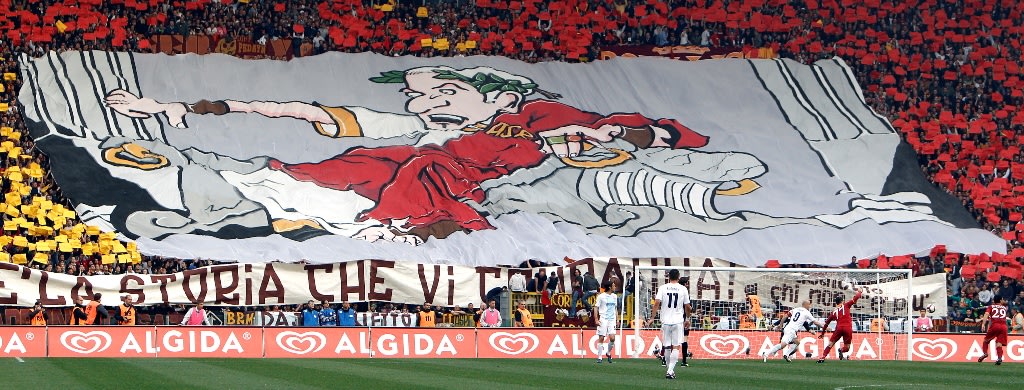
My club loyalty lies as AS Roma of the Italian Serie A. While I am of Italian origin, that isn't the only reason why Italian football appeals to me. I like it because of the insane passion of the fans and the tactical nuances. The former has its ugly side: fans racially taunting black players, shining laser pointers in the eyes of free kick takers, littering the pitch with plastic water bottles, etc. But these unsavory instances are more than compensated for by the palpable tension and drama that surrounds each match.
Historians are certain that Caesar supported Roma while Pompey was a Lazio Fan
Tactics is everything in football. Part of this has to do with the rules: the only restriction regarding formations is that there must be one goalkeeper and ten outfield players. Formations come and go like fads. Today's 4-3-3 is yesterdays 4-4-2. Different countries have different theories about how to approach the game. For example, Italy lacks true wingers so Italian sides typically rely upon the fullbacks to both defend and go forward on the wings to contribute to the attack. Tactics is also a big deal because unlike in other sports (basketball, hockey and American football among others) football substitutions are limited to just three per side. So if a manager misjudges his counterpart's strategy, it could cost him the match even if he has the chance to switch things up by making a change. The manager also can only really communicate with the players before the match and during the halftime interval given the lack of stops and crowd noise. Getting the tactics right is crucial and allows little room for error.
Because playing with a centre forward is so mainstream...
A lot of this tactical awareness is less important in MLS since many sides use a so-called workman's approach to the game. The idea of this is to play the ball up the wings and cross it into the box where the forwards can pounce on it and drive it toward goal. Alternatively teams will boot the ball upfield in hopes of allowing the forwards to slip in past the defensive line (thus avoiding offsides), leading to a fast break opportunity. Like any style of play, these tactics can be effective with the right players. But they don't allow the viewer much excitement. It is simply boring to see teams resorting to the long ball and "head tennis" because they lack on the ball skill. Similarly it is less fun to see a defender sloppily hack the ball out of danger instead of calmly and confidently playing it to a nearby teammate in his own half (though there are times when the former is the only option).

This is where creativity comes in. Vision. The ability to read a defense and make that impossible pass to a teammate at just the right time. American soccer suffers from a lack of players that can do this effectively. Many argue that this is because the game is taught at the youth level in a manner that emphasizes constant running and team work rather than slowness and individual flair. The problem with this stance is that it disregards the possibility (or even probability) that a player blessed with essentially unteachable on the ball skills can also contribute to the team by sharing the ball when needed. Soccer is a game in which creativity is often needed in order to score goals. A player who is brilliant on the ball is not necessarily a ballhog (Arjen Robben being an exception), and letting that player have free rein with the ball draws defenders onto him, thus allowing him to pass to an open teammate. This type of player is called the trequartista in Italian, he usually wears the 10 shirt and is set up behind the strikers. The playmaking role is hardly unique to Italian football, but these types of players are more prevalent in countries in which creativity and individual brilliance is prized over the ability to be selfless and run hard throughout the match. The US have a player of this stripe in Landon Donovan, though his performances for the national team and San Jose and Los Angeles in the MLS have far outshone his mediocre numbers while playing in Europe.
Do you recognize this man, America?
This all being said, MLS deserves some commendation. Take growth for instance; from its modest beginnings of 10 franchises in 1996, the league has swelled to 19 teams. By next season that number will be 21, with Orlando and the second NYC metropolitan area team joining the fold (as of now only LA has two teams). Parity is also one of its strong suits. In its 18 seasons, no fewer than 9 teams have lifted the MLS Cup. To put that in perspective, over the last 18 seasons, only 4 teams have won the English Premier League. This lack of parity is common in Europe: just 5 different teams have won the Serie A, 4 Spanish teams have won La Liga, incredibly only 2 clubs have won the Scottish Premiership in that time. It is also exciting to be involved with something from its inception. If you follow a European club this is impossible since the vast majority of them were founded in either the late 19th century or early 20th century. Many clubs "fetishize" their glorious past and or humble founding (1860 Munchen, Bayer 04 Leverkusen, Hannover 96 to name but a few German examples). Also, while racial abuse by fans toward players has improved in some parts of Europe (England) more so than in others (Italy unfortunately), this problem is essentially unheard of in MLS.
Age matters apparently
However, for all MLS's strengths, the league still has a long way to go to make it more watchable. This could be helped if the league considered using a relegation/promotion system, where the bottom teams in the top division are relegated to the second division and replaced by the top teams in the second division for the next season. Sponsorship money goes down when a team is relegated to a league with fewer spectators. This prevents a team from being very bad for a long period of time (Chivas USA have missed the MLS playoffs four years in a row). This system is ubiquitous in Europe because the top and lower leagues are old and interconnected. This is not the case in MLS, so one is deprived of one of the hidden pleasures of football: end of the season relegation "playoffs" where bad teams desperately fight for the right to remain amid the glamour of the top division, if only for one more season.

Integrating promotion/relegation into the MLS would be a gargantuan undertaking and would theoretically defy the league's plan of adding franchises and so growing the sport. The problem also remains of whether MLS fans would still support their team if it was relegated to the second tier North American Soccer League. Alternatively the MLS could simply split in two, but the question of continued support would still be there, plus there would be no even split unless the league has an even number of clubs (it doesn't and won't next year). Despite these valid concerns, a system that rewards competence and penalizes incompetence would certainly improve the quality of play in MLS, and many have been clamoring for this type of change.

For some American soccer fans my disdain for the MLS would make me the object of endless scorn. Those more tolerant would argue that I merely want to watch a league with some of the world's greatest players, the same way a Turkish NBA fan may be less passionate about the Turkish Basketball League. I am a football aesthete. One of the reasons I chose to support Roma is because they have always played a free-flowing attacking type of football. Those more open-minded would accept my Eurosnobbery as long as I still support Team USA.
Great kit, not so great team
Well I'm sorry to disappoint everyone but the truth is I only have room in my heart for one national team and that team is Italy. I played soccer a little as a kid (who in America hasn't really?) and I did watch some MLS in its inaugural season, but I was drawn to the European game first. I think it all began by happening on a Champions League telecast one afternoon after school in 2001 or 2002. To borrow a hackneyed phrase, it was love at first sight. After that I started watching Serie A on Sundays via a frequently fuzzy and hopelessly ancient feed on WYBE, a local public television station. It was an almost seamless transition from being soccer ignorant to cognizant of the pantheon of the world's greatest players, Italian or otherwise. Perhaps it is shallow to admit it, but the lack of American players among the world's elite at least partially drew me away from the US national team. The other factor drawing me toward supporting the Azzurri is my ethnicity and that many Roma players have played for both club and country, whereas it was not until 2012 that Roma signed an American player (Michael Bradley, who is now back in the MLS).
NEVER FORGET 
When you support a team that has won four World Cups and one European Championship you are always ready to defend yourself from those calling you a bandwagoner. I celebrated when Italy won the 2006 World Cup, and I also won runner up in my high school's tournament pool. But in order to justify celebrating that victory I had to endure the offensive ineptitude of the Euro 2004 campaign, in which Italy failed to qualify out of a supposedly easy first round group. When South Korea eliminated Italy in the 2002 World Cup knockout rounds I was befuddled, and the 2010 World Cup is inextricably linked with the word vergogna. A bandwagon fan is marked by inconsistency. I have been consistent in supporting Italy, it just so happens that they have won the World Cup and finished runners up in the Euro championship since I have been a fan.
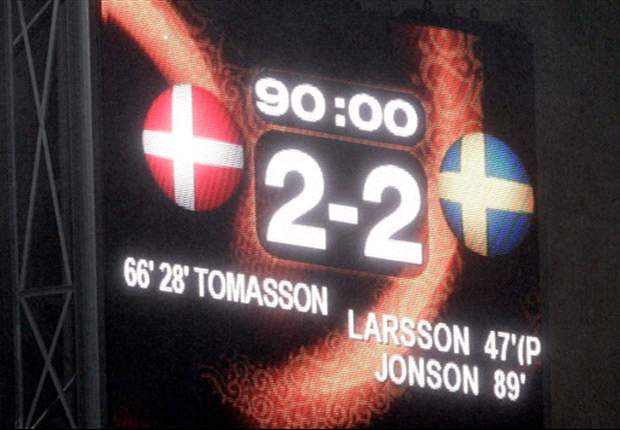
You probably remember this...
But do you remember this too?
To me the biggest threat to American soccer is not the fan like myself, loyal to a single foreign club and country. Rather it is those who support multiple teams and countries, just so long as they are not American. You know the types: Real Madrid/Barcelona fan when watching La Liga, Man United/City/Liverpool/Arsenal/Chelsea "diehard," Juventus/Milan/Inter supporter and Bayern Munich fanatic all rolled into one. Oh I forgot P$G in there but you get the idea. Furthermore I don't understand those Americans that root against the US national team (besides Mexicans due to their rivalry).

I try to be as neutral a fan as possible in games not involving my teams, though I admit that neutrality only goes so far. Neutrality bows to circumstance. For example, I would not have been upset if Ukraine had qualified out of their Euro 2012 first round group because it would have been a proper sending off for their captain Andriy Shevchenko. I spent years rooting against Sheva as a Milan player especially, but he was probably the greatest pure striker in the world in his prime. It would have been a nice human interest story to see him win something in a Ukraine shirt. That didn't happen as Ukraine finished third in their group. However, it was great to see him end his international career by scoring two goals in a win over Sweden in front of his home fans (Ukraine co-hosted the tournament with Poland). Of course, Ukraine weren't in Italy's group in that tournament. Had they been, this entire human interest story wouldn't have appealed to me. Sheva and his countrymen would have been the adversary and nothing more (as they were in the 2006 quarterfinal when Italy trounced them three-nil).

#RESPECT 
So to sum up: I watch football that I am culturally and aesthetically attracted to. I'll still watch some MLS this year as a neutral with the slightest bias toward the Philadelphia Union. If they do well, I'll be happy the same way a father would be happy if his son's high school team made regionals. Content but not triumphant. As for the US national team, I hope they win the World Cup if Italy doesn't. Though who am I kidding, either Brazil or Argentina will end up winning it. So I'm still partisan toward the game I love but every football fan is partisan one way or another.

Saturday, November 9, 2013

Double Indemnity

Double Indemnity. Cain, James M. 1935. New York: Vintage, 1989.

Reading this novel is like striking a match and becoming entranced by the intricacy and aesthetic beauty of the flame until it dissolves and you close the book and never want to write another word because you will never be as clean a stylist as James M. Cain is. Of course, if you've no aspirations about writing then you won't have have to stomach that dose of pessimism upon finishing Double Indemnity. This book is like 99% fat free ground chuck...there is literally nothing in it that is unnecessary. No florid pretentiousness. No "bet you can't understand this" anatomies of a murder. No stilted cliches. One wonders how much Cain had to edit out of his earlier draft(s). It is a fucking shame that most people will probably think that it was only a movie screenwritten by Raymond Chandler, and not an absolutely great novel written by someone else less famous. As good old Horace says, I don't like slobbering plebeian entertainment fiend idiots, and I stay away from their shit. Or something like that. By the way, this book is so damned readable that it will probably only take twice as much time to read as it would take to watch the film. Have I made myself clear, class? Stop bitching about how Wilder's adaptation didn't win any Oscars and start bitching about why Cain isn't a household name.

Double Indemnity is about Walter Huff, an insurance salesman in seedy LA who meets the seductive Phyllis Nirdlinger who is unsatisfied with her married life and drops a hint about purchasing accident insurance for her husband without telling him. The narrator, experienced in insurance sleaze in a noirish kind of way, picks up on her hint and becomes her partner in crime because he falls in love with her. The narration is done in a first person, confessional manner by the seemingly ordinary Walter, who meticulously maps out not only how to kill, but how to get away with killing. Inevitably though, complications hinder the lovers' plan, in the form Walter's suspecting coworker Keyes and with Phyllis's daughter Lola, along with her supposedly ne'er-do-well boyfriend Sachetti. I'm not saying another word about the plot of this novel because it's only 115 pages long and if you start it, you will be psychologically obliged to finish it (unless you happen to start it when you are bleeding to death or in some other kind of grave danger).

The only problem I have with this wonderfully dark story, the teensiest little speck on an otherwise gleaming, flawless canvas, the mole on the Mona Lisa if you will, is that I found the attraction between the lovers and co-murderers a tad unbelievable. What I mean by this is that after Walter executes the murder, for obvious reasons he cannot be seen with Phyllis because he sold her the insurance policy. This distance causes Walter to kind of fall out of love with her but simultaneously fall in love with Lola (with a little pity toward her thrown in for good measure). Perhaps the sparseness of the narrative here does not work to its advantage, as a more wordy style would make the attraction seem more plausible. Indeed, in novels of this type, call it noir or hardboiled or whatever, it is usually the crime that seems more believable than whatever romance springs up from the well of the plot. But look, if you want a book that describes romance in a more realistic way, there are only millions of others to choose from. So quit complaining. Besides, how can you hate on a style that is this controlled?

I drove out to Glendale to put three new truck drivers on a brewery company bond, and then I remembered this renewal over in Hollywoodland. I decided to run over there. That was how I came to this House of Death that you've been reading about in the papers. It didn't look like a House of Death when I saw it. It was just a Spanish house, like all the rest of them in California, with white walls, red tile roof, and a patio out to one side. (3)
...
   Her brow wrinkled up, and I saw there was nothing washed-up about her. What gave her that look was a spray of freckles across her forehead. She saw me looking at them. "I believe you're looking at my freckles."
   "Yes, I was. I like them."
   "I don't."
   "I do." (11)

SSSNNNIIIIP...SNIP...SNIP...SNIP...SSSSSNIP. You hear that? It's Cain cutting the bullshit out of description and dialogue in a way that would make Hemingway blush. This novel is minced onion while most others contain far too many semi-sliced chunks. It's lean but mean. Clean but sordid. Stylistically straightforward but emotionally conflicted...and why shouldn't it be this way, since it's about a man who kills for love and regrets it?

Friday, November 8, 2013

The Thin Man

The Thin Man. Hammett, Dashiell. 1933. New York: Vintage, 1992.

With more red herrings than a fish market, The Thin Man is the perfect example of an important work that it is easy to respect but hard to love. It is important in that Dashiell Hammett was really the first writer of noir fiction, a genre that has never lacked devoted readers and writers. The story concerns Nick Charles, a former San Francisco gumshoe who is on vacation in New York with his wife Nora when he suddenly learns of the murder of Julia Wolf, former secretary (and mistress) to Clyde Wynant, an eccentric inventor who previously employed Nick to tail a jealous rival inventor who claims Wynant ripped him off. Nick starts getting messages from Wynant, asking for his help in finding Julia's murderer through the latter's attorney Herbert Macaulay, who served with Nick during the war. Despite his better judgment, Nick gradually becomes involved with the case as well as with Wynant's family: his controlling and dangerous ex wife, strangely bookish son and beautiful but naive daughter. Double crossings and acts of violence ensue as Nick becomes more involved in solving the crime.

Ultimately, the novel is a disappointment given that it starts so strongly. The reader is immediately drawn to the cool world weary charisma of Nick Charles, the archetypical PI who has seen evil in its many incarnations. The main problem with the book is that the concepts it relies upon eventually grow stale. The jokes certainly have not aged well. Reading this book in and of itself is almost a kind of detective work in that one must determine not what is, but what isn't a lie. There are simply too many characters, many of which end up contributing nothing to the plot besides artificial drama. Unnecessary characters aside, one wonders whether this story could have worked as a piece of short fiction instead.

This novel is less a work of noir fiction than a progenitor of the whodunit. One should not dismiss Hammett solely on grounds of this novel; his short stories are excellent in that they are imagistic, with hardly any of the narrator's or other character's thoughts expressed. Stylistically, Hammett is almost surgical in his economy. One cannot deny his ability to write clearly and distinctively. But the story is simply too complicated for the reader to follow along, and there is remarkably less action and bloodshed than the reader would expect. Much of the narrative consists of Nick relaying new information from one character to another; information that he gets from unreliable sources. The contrived nature of the plot alienates the reader. One of Hammett's earlier short stories "The Man Who Killed Dan Odams" is the epitome of simplicity: a man breaks out of jail and hides out in a remote house, taking the woman and boy who live there hostage. He reveals his identity to them, and this leads to his downfall as the they are the family of the man that the protagonist killed (which got him thrown in jail in the first place). What is remarkable about that story is that it is so pared down that there is nothing unnecessary. So focused is the author that every little detail serves some purpose. The images tell the story—in true noir style the thoughts of the characters rarely break into the narrative.

There is little of that precise focus in The Thin Man, even though as far as novels go, it is rather short. If anything, this book tends more toward hardboiled fiction, but it is nowhere near as effective a piece of writing as say, James M. Cain's Double Indemnity. One gets the feeling that this work is less a story than a kind of gigantic math problem with the final chapter (in which Nick explains to Nora how ——— murdered Julia Wolf et al.) serving as a QED flourish.

Monday, September 30, 2013

Tampa

Tampa. Nutting, Alissa. New York: HarperCollins, 2013.

POST UNDER MAINTENANCE

Saturday, July 20, 2013

Far From the Madding Crowd

Far From the Madding Crowd. Hardy, Thomas. 1876. Naples, FL: Trident Press International, 2001.

Cuter than a Wes Anderson set, this is the tale of a Victorian hottie who has to choose between three horndogs til she finds the right one—like Goldilocks and the porridge. Bathsheba Everdene has recently inherited her family farm, which in modern terms is like saying her STACKS of GREEN are so high that she can't see the HATERS. Naturally Bathsheba becomes Weatherbury's hottest commodity and the servants start gossiping about who is to take her hand (and farm and something else ifyaknowwhaimsayin).  In an interesting feminist twist, Bathsheba decides to try to run the farm herself which is entirely inappropriate for a young hardbody. Y'all saw that reality show with Paris Hilton and her friend having to work on a farm right? Farming ain't the province of beautiful ladiezzz. Bathsheba attempts to master buying and selling crops at market but realizes that she ain't cut out for that shit. What she needs is a man to manage the boring stuff while she chills in her mansion and gossips with her BFF Liddy.

At this point she has already turned down one of her suitors, the indefatigably honest shepherd Gabriel Oak, who is still getting over it. Oak ain't the most socially adept bloke in Wessex because he proposes to Bathsheba like the second time that he meets her (and before she becomes Bath$heba). Girl is freaked out for reals. But Oak is a morally upright character who, as is typical of Hardy, gets tragically fucked over by the forces of fate. His mutt goes berserk and drives his flock over a cliff leaving Oak to have to pay back the deposit on the animals. Just like credit card debt...sooner or later you gotta pay up for all those borrowed dollars/sheep, naimsayin? Oak settles with his creditors but has no green leftover for himself. But his good nature ends up getting him a job, as he proves to be adept at saving a corn harvest from a sudden fire. The locals put in a good word and Bathsheba decides to hire him even though she kinda knows that he is sooo not over her. Also Oak is a master shepherd and there's this one scene where the sheep start dying of this rapidly accelerating disease and the farmhands are powerless to stop it and Gabriel is all like EVERYBODY CHILL THE FUCK OUT I GOT THIS. Except he didn't curse like that but he has that kind of confidence about matters of sheep.

Bachelor no. 2 is Boldwood, and the first part of that portmanteau is a misnomer. Boldwood is a stick-up-his-ass...I mean stick-in-the-mud sort of fellow who has a good reputation in the community, but like Oak he isn't the type to spend his vacay in Ibiza. Boldwood takes a fancy to Bathsheba after the latter, in a totally girly move straight out of seventh grade, conspires with Liddy to send a letter to Boldwood that says "MARRY ME AND MAKE ME GO UNNNNH UNNNNH UNNNNH" (OK I made that last part of it up). Teehee. Girls can be so capricious and conniving, amirite? Bathsheba doesn't really fancy him but TOO LATE SINCE BOLDY AIN'T NEVER GONNA FORGET THAT. Girl, you don't tempt a lonely, reserved farmer like that and expect he's not gonna take it seriously! So Boldy now fancies Bathy and she's like "jk lol sry about that" and he's like "you cruel bitch...I mean you delightfully angelic creature who has acted cruelly toward me!" See, Boldy is one of those idealistic lover types and since he has fallen in love with Bathy nothing shakes him out of it. I'm talkin' Heathcliff style bitches, 'cept his love is unrequited.

But look, a challenger approaches! It's Sergeant Troy: rogueish, fit, Anglo-French, Byronic badboy with a sword. Troy is all about breakin' rules and breakin' hos. His idea of a good time is a Casterbridge pussyquest during a furlough and while this lad has class, he's a right proper socialist, baby, when it comes to the ladiezzz. Meaning he likes the servant girls as well as the rich bitches. Meaning he has sex with runaway servant babe Fanny Robin (you expected a fanny joke there didn't yer?). Prolly the best scene of the novel is where Troy tries to seduce Bathsheba using his sword trick. He blindfolds her and wields his peen-blade marvelously all around poor Bathy but he promises that it never touched/penetrated her. Wooing...you're doing it right.

Bathy is totally into him even though Oak warns her that Troy seems to be a...how you say...WANKER. Oak suggests she marry Boldy instead, but rich bitches get what they want (even in Victorian times, reader) so the two hotties marry each other. Oak's crit of Troy ends up being spot on since he dunno a thing about farming and the like and attempts to ingratiate himself to the servants by getting them plastered. Unfortunately this happens right before a storm is about to brew so everyone is too drunk to remember to cover the corn harvest. See, in this book corn is like the same thing as money so it is even more shocking to find out that poor Boldy has been neglecting his crop ever since Bathsheba turned him down. Oak comes to the rescue, as per usual, and manages to limit the damage, but Bathy won't have a servant instruct her on her love affairs so she has little patience for Oak stating the obvious fact that Troy is a...how you say...douche. However she seems to allow Liddy to give her love advice, which must fall under the "girl talk exemption clause." Troy also has a taste for gambling and since he's married to Bath$heba "Cha-Ching" Everdene, he's always like "canna yer lend me five quid for the races—I mean investments—that I am looking into?" At the same time Troy is carrying on a sexy affair with Fanny, but Bathy never fully catches on (though Oak does).

This is a Hardy novel so TRAGEDY STRIKES. Fanny, exiled in shame in a Victorian workhouse, dies from unknown causes (broken heart? VD?). Troy and Bathsheba are absolutely shaken and they handle the funeral which (conveniently) allows Fanny's body to rest at the house before burial. Oak covers the casket because he does not want Bathsheba to know the truth about Troy's phallic escapades. But alas, in her grief Bathy opens the casket to find that poor Fanny was with child. Troy's evasiveness toward her about Fanny and the fact that he carries a lock of her hair in his watch allow Bathy to piece together that her douchebag husband is unfaithful. The marriage falls apart and Troy wanders about, only to go for a swim and (conveniently, for later purposes of the plot) leave all his shit on the shore. He is carried out by a strong current and a bystander reports that he has surely drowned.

News reaches Bathsheba that she is newly single and ready to mingle but she's in no mood for fun. Poor girl still blames herself for Troy's treachery. But the news excites someone in Weatherbury...dear old Boldy, still nursing his lust for Bathsheba. He's like "Hey girl, now that your husband is out of the picture, how about we elope lol" and she's like "um...I could only marry for love and I don't love you" and he's like "s'cool I'll just bother you about it all the time and remind you about how you fucking played with my emotions with that letter so much that I wished I were dead. You owe it to me bitch." While it is true that Bathsheba wants to marry for love she also believes that Troy is not dead since they never found his body. And wouldn't you know it, but her wifely instincts are right! Troy survived and was picked up by a ship and by some naked, cray cray method makes it to America where he becomes, and I quote, "Professor of Gymnastics, Sword Exercise, Fencing, and Pugilism." Then he remembers that he has a hott wife waiting back in Engerland so he returns and takes the perfect job for a disgraced-husband-seeking-to-win-back-his-wife-and-her-estate: he joins the bloody circus. His object is to get a sense of what Bathy is up to and how disgraced his reputation is with her and the town folk.

Everybody who's anybody (livestock included) show up at the Sheep Fair at Greenhill, where Troy plays the performing role of legendary highwayman Dick Turpin. In order to conceal himself he has to rely on disguising his face and limiting the speaking of his part and he seems to pull it off as Bathsheba does not notice...but the narsty baliff Pennyways does. This Pennyways was sacked by Bathsheba earlier on for stealing grain so he's desperate to curry her favour by informing her that her hubby is alive and well. But Troy has other plans; he follows Pennyways to the tea tent where Boldy and Bathy are having a quaff and after Pennyways gives her the note which says that her husband is alive, he furtively reaches from behind the curtain and snatches it from her before she has a chance to read it.

Meanwhile Boldy guilt-trips Bathy into considering the prospect of marrying him in six years, because at that point Troy would be considered dead and she could then legally remarry. They agree Bathsheba will give her answer at the upcoming Christmas Eve bash at Boldwood's crib. Troy consults with Pennyways' and with his help constructs a costumed disguise (of the type that work in novels and not in real life), intending to gatecrash and wifegrab with one swift stroke. But news of Pennyways' discovery of Troy spreads throughout Oak and the farmhands. They decide to tell Bathy the truth before she foolishly commits to Boldwood but (conveniently) they haven't the heart to break up the absolutely bonkers partay. Boldy's plan to strong-arm Bathy into being his betrothed works and she agrees that she will marry no one else until the time period elapses and she will be his. Boldwood, raging with a boner of joy, gets hammered and welcomes a new stranger into the house who just so happens to be Troy. He orders Bathy to leave with him and Boldy snaps and shoots the adulterer. Bathy feints. Troy dies. Boldy turns himself in (but is spared the noose).

TIME PASSES and the town folk start treating Bathsheba like she's got a case of the crabs. I'm talking glacier cold, and the worst of it is that Oak avoids our poor hottie as well. Bathsheba no doubt thinks that Oak has saved her ass like three times and has had enough and that is why he wants to leave England for Cali. But she's wrong, my friends, because if there is one true theme in this tale of cattle and cads, horse dung and horndogs, it is FRIENDSHIP. Oak and Bathsheba's relationship oscillates from Death Valley to the bloody Matterhorn but they never give up on each other and so it is only natural that this wonderful novel ends in their marriage.

Is this book too dated for modern readers? (It isn't...BYDHTTMWFI). Read it and decide for yourself.

Keep turning those pages, readers.


Sunday, July 14, 2013

Glamorama

Glamorama. Ellis, Bret Easton. New York: Vintage, 1998.

This is my favorite book of all time. I'm often at a loss as to how to explain why I love it so much, since I generally don't care for American fiction. I think the reason why is that it offers an invigorating reading experience. You will get the full gamut of emotions from this novel. It is as likely to make you laugh as it is to make you cry as it is to make you wince as it is to make you hurl as it is to turn you on. If you can make it past the first third of the narrative then you will likely finish it, as at that point it takes a three hundred sixty degree turn. Not a full turn, since the protagonist Victor Ward's character never really changes even if the plot does.

Glamorama is an achievement because the world of vapid supermodels does not seem well fitted to literature. After all, in a profession where one look says everything who cares what anyone says? And indeed, this book is filled with trite and ridiculously banal dialogue. Victor Ward has the philosophical depth of a paper plate. It is only when his life and everyone in it are endangered that he even begins to act introspective, to comprehend the magnitude of fashion in bed with terrorism. As the book goes on there is less of the label conscious itemization that has been attacked by so many critics and retched at by so many readers. Vicariously we want to be Victor Ward because of who he sleeps with and who he hangs out with. We are superficially in love with what he is capable of, even if he himself stands for nothing. He is an imbecile, but some of us would willingly give up their intelligence in exchange for that body and what comes with it. As it is with Ellis, surface is what matters.

What many fail to pick up on is that this book is a satire. Ellis does not praise the fashion industry in Glamorama. Instead he viciously attacks it. None of his characters are happy because they are too busy being hip; they prefer pouts to grins. The smell of shit is a repeating trope in this book, jockeying for position with the Chanel infused molecules of the hippest of parties. The claim that models can become terrorists is reasonably sound given that their lives are all about access: what exclusive clubs they can get into and what material pleasures (drugs, sex) come with that. Perhaps it is simplistic to say that models are docile, unquestioning (but good looking) pieces of meat, oblivious to questions of morality or sexual decency. But you have to admire the courage of this author because he absolutely does not back down from making that claim. Ellis is the type of writer who is not afraid to scare and offend you. It is these types of writers who come to define an age, not the mildly shocking drivel of the "pick your genre" crowd. Where others feint a strike, Ellis delivers a knockout punch. Read it to understand what the 90s were about and prepare to be shocked and amazed.

Monday, May 20, 2013

Brighton Rock

Brighton Rock. Greene, Graham. 1938. Harmondsworth, UK: Penguin, 1970.

Graham Greene achieved the seemingly impossible: he was popular with the common reader as well as the critic. But once you read his works you can see why. If there is one thing that people who read literature love it is commiseration. His books are a celebration of commiseration. Not emo depressing commiseration. I mean commiseration as in the constant reminder of how many emotional wounds the business of living requires. It is commiseration combined with tolerance that defines Greene's writing. He is so very aware of the difficulties that his protagonists face. He does not dismiss them in a nihilistic way. He expounds on their suffering but without being overly melancholy. It also helps that he has extraordinary powers of imagery. So one can see why his books are so relevant and readable.

To write about the rich, the all-powerful and the intellectually charming is the easy road. That does not mean that writers that focus on these matters should be dismissed. But to limit the intelligence, freedom and power of your characters requires more skill. This is especially true with matters of intelligence since it can be assumed (but maybe not proven) that all writers of literature are intelligent. It is easy to write about intelligent people who love conversation but harder to write about those that use language in a stoic, utilitarian manner. Introspective people make wonderful characters but not everyone is introspective. Sometimes the decision to not speak does not mean that the person has some hidden thought that justifies the choice. To write about the ignorant and feeble-minded truthfully requires a great use of imagination since it requires the writer to lower himself. It is for this reason that we admire books that deal with the sordid. As I Lay Dying (birthplace of this blog's title). Wuthering Heights. Sons and Lovers. There are many examples. We enjoy these stories about the poor even as we cling to our Austens, our Waughs, our Fitzgeralds.

Brighton Rock is an achievement because it concerns sordid people grounded in a provincial mindset. Pinkie's gang are laughable excuses for gangsters. They seem on the verge of destitution yet they continue to risk being caught and hung for the transgressions. Perhaps this is typical of prewar gangs but the promise of wealth seems to be the main reason why people break the law for a living. Yet Pinkie's gang never seem close to a windfall. Furthermore they are constantly reminded that Brighton is the turf of the slick Colleoni (who fits the gangster archetype a little better). One gets the feeling that Pinkie and his cohorts are gangsters because they are ignorant and don't know any better. Rose is stupid. Her limited intelligence does not deserve a more exhaustive adjective...though one feels for her poor upbringing. She is an example of someone that is given absolutely nothing bar the fact that her parents are alive (even though they are depicted as cretins). Even the heroine Ida Arnold is a working-class girl fueled by good sense grounded in pleasant but limited maxims. Her relationship with men borders on prostitution, or at least it probably did in the 1930s.

There is a certain degree of duality in this novel. It is a tightly drawn, intricately plotted mystery stemming from the ramifications of the death of a newspaper salesman. But it is not mere noir. Like others works of Greene, there is a distinctive Catholic element at play as Pinkie and Rose are both "Romans." Part of their Catholic identity is shaped by how Catholicism is defined in opposition to Protestantism (a betrothal instead of an engagement, the rigor of Catholic schools, how attending Mass on Sundays is the path to heaven). But the other aspect of it is purely sexual. A reader would be hard-pressed to find a book that approaches sex with such a degree of repulsiveness. Of course the repulsiveness is not universal (what is fun to Ida is sickening to Pinkie). But Brighton Rock reminds one of the story of the child who sees his parents have sex and is spiritually (and psychologically) cursed afterwards. This is what happens to Pinkie and it shapes him into a teenager who is utterly disgusted with his burgeoning sexual yearnings. Pinkie is not really a psychopath since he holds out on a rather forgiving view of the faith; that confession at some point before death equals absolution. One could argue that he has transferred his sexual urge into an urge for blood (and that is certainly less healthy than the other way around). Yet Graham Greene is too smart, too human a writer to present only one side of Catholicism. He does not dismiss it as self-flagellating and overly tense because of its sexual close-mindedness. Rose trusts the murderous Pinkie and can only absolve herself by means of confession in the final scene of the novel. And even though the record of Pinkie's wrongs is clear, the priest sees his love for her as evidence of his innate, God-given goodness...even if only scraps of it.

Monday, June 4, 2012

Night and Day

Night and Day. Woolf, Virginia. 1919. London: Grafton, 1987.

Why bother with Virginia Woolf? When one reads her one gets the impression that he has ventured into exalted territory—a domain in which every intricacy of the English language is exploited and celebrated. In short she is not for beginners and occupies a perch beyond which lies that radical branch of modernism that does not make literal sense, where cohesive thoughts and sentences are not taken for granted.

Yet despite these and other flaws (in addition to a voluptuous use of English a stubborn Metropolitan snobbery exponentially stronger than Woody Allen) she is worth a writer's time. I could say the same for readers but there are plenty of great writers who are easier to digest. Woolf is a writer's writer and if one is not too interested in the craft of expression then she may not be worth the effort.

But her prose is so damned good—so good that you wonder how anyone could write this well. Writers and aspiring writers can and should love her (or at least substitute envy for admiration).

Night and Day is not a novel to read for the plot. Typical love triangle. At the centre is Katherine Hilbery—rich, beautiful, noble, well-bred and yet flawed. Katherine does not know how to love and would prefer to entrench herself in calculus and astronomy. This despite the fact that she is of poetic nobility as the granddaughter of a fictional prototype of Lord Tennyson. Indeed Katherine is the perfect  foil to the extraordinary character of her mother who is eerily similar to a hippie except she predates Woodstock by half a century. Katherine is no poetry junkie (despite her bloodline) and does not wax poetical about stepping on the hallowed ground upon which the Bard may have squatted as her mother does.

Perhaps the two do agree on one thing: don't marry a man unless you are in love with him. Katherine almost breaks this rule when she is engaged to Rodney, who by all accounts should be her perfect match. Rodney is an academic sort but he is not privileged enough to earn his bread solely by means of his Elizabethan monographs (though he licks his lips at the possibility once entered into the Hilbery fortune).

Katherine must hear his blatant poetic rendering of herself as the Muse even though it is rubbish and she can't believe it. Her noble resolve is finally broken (as is the engagement) not by means of a frank declaration that she does not share Rodney's love...at least, not originally. Katherine only becomes forthright after her apparent public ridicule of Rodney forces him to chastise her in a effort to justify the apparent emasculation. We are speaking of nothing particularly devastating (at least by today's standards). Apparently agreeing to take a walk and then standing one's partner up is enough to constitute ridicule according to Rodney. Despite his devotion to literature he is still attuned like a satellite to the public opinion of himself in elevated Chelsea circles. He seems to lack the poetic abandon and fearlessness towards scandal that is sometimes expected of those who write verse.

But Katherine is a woman of class and women of class eventually have to settle. She has not the unfettered quality of her friend Mary Datchet whose life is fueled by the passion for justice that is a necessary consequence (for those modern and enlightened) of Parliament's beastly avoidance of the suffrage issue. Woolf seems to suggest that Katherine is not a woman of ideals precisely because she has money. Or perhaps she is a woman of ideals except that her ideals are personally and purposefully dehumanized (mathematical figures; constellations in the sky). Perhaps it is a facile treatment of the sciences but Virginia Woolf probably never would have called herself as a scientist.

Anyway Katherine settles for Ralph Denham even though he shows similar attributes of the idealistic, fanatical, "head in the clouds" love that she rejects from Rodney. Katherine's social status towers over these two male friends of hers and to both of them she does not reciprocate their love. Yet in the end she chooses (or considers or settles upon) Ralph. Both men adore her and she ultimately rejects the respective angelic depictions of herself but there is a difference that draws her to Ralph.

It certainly helps that Ralph (unlike Rodney) does not fall for the youthful, exuberant Cassandra, dearest cousin of Katherine. Cassandra, due to her inexperience, lacks the cruelty of Katherine; she must learn  how to ridicule a man as society has not endowed her with the foul seeds of that knowledge. Things don't end happily for Rodney but it is perhaps excusable that he falls for a relation of Katherine's. It is also excusable (and perfectly reasonable) that Katherine almost welcomes the news as a feasible (if controversial and scandalous) way of justifying the end of her engagement to her parents.

Yet it is scandal that marks the difference between these two intellectual young men—in particular Ralph's complete lack of fear toward it. He is perfectly alright with making a fool of himself by staring into the window of the Hilbery drawing room. So deep is his love (or infatuation or vision) that the poor man cannot help it.

The ending of this novel is beautiful in that there is a working agreement; a compromise between the two (dare we call them lovers?). It is majestically left unfinished as it should since the two of them must resolve the different visions of their relationship.

No doubt Katherine expresses the view of Woolf in that true knowledge of another person is impossible (even among lovers). She cannot believe that if she loves Ralph the way he loves her the world would suddenly change for the better (as Ralph believes). But she is willing to try to believe it and perhaps that's all that love is, or at least all that we can expect of it.

Wednesday, May 9, 2012

The Informers

The Informers. Ellis, Bret Easton. New York: Vintage, 1994.

Generally considered to be among the weakest of Ellis' works, The Informers is a victim of its own form as the author's only short story collection. In a way it qualifies as a novel since many of the characters from Ellis' universe reappear and interact. The problem is the utter anonymity of Ellis characters as well as the uniformity of their appearances. The latter is expressed strongly in American Psycho in which one of the running gags (or tropes) is how Patrick Bateman is unsure of the identity of the people that he sees at parties and clubs. In fact, Bateman himself is completely mistaken for a colleague by Paul Allen simply because both he and his doppelganger wear Armani suits and Oliver Peoples eyeglasses. Whether or not these two men have different personalities is inconsequential. Ellis is all about "surface, surface, surface" (to paraphrase the man himself).

Why doesn't this work in The Informers? Because the incredibly toneless narration robs the cast of any semblance of sympathy and cognizance to the reader. It's hard enough to stomach a dose of absolute nihilism in a novel with a coherent plot and a protagonist. The short story form makes Ellis' words even more unhitched from anything approaching morality, justice or decency. If you don't care about an Ellis protagonist; a Clay, Patrick Bateman or Victor Ward, then why would you care about a narrator who you only have twenty pages to get to know?

This problem is compounded by the necessarily Ellisean aspect of characters. Or to put it rhetorically (for those that have read the book): what is the difference between Tim and Graham? Besides the obvious connections to each character (parents, who they are fucking, etc.) there really is no difference. Both have the same personality, same interests, both are wealthy, hang out at the same places, even dress similar. Even in appearance Ellisland is uniform: blondness, tallness and attractiveness are ubiquitous. The only ethnic minorities in The Informers (besides some Hispanics used as scenery) are surfers.

The result is that when one reads this novel one often forgets just who is who. Unlike in Less than Zero (which is pretty close to this novel stylistically) there is no main narrative to hold together the plot and the reader's attention. Ellis has publicly stated that the film adaptation of this novel was the greatest of the four that have been done on his work and it's no wonder why. What the film is able to do is to lace together the independent stories (albeit at the expense of some others that are left out) in a way that is never really done in the novel since there is no sense of chronology. The result is that we know why Martin is not Graham and Graham not Martin. In the book the distinction is much less clear.

Ellis is not one to place particular attention toward development of character as his premise is that surface develops character far more than do thoughts or emotions. So much of Ellisland is about being the right type of person at the right types of places having access to the right types of debauchery and sex. Whether or not you happen to be eloquent, sympathetic or even coherent is far less important. There is no room for free thinkers in such a morally depraved view of the world. Though Ellis never makes this point clear in his work, his devotion to surface and its nihilistic consequences makes him a moralist, albeit a subtle one.

The Informers is imperfect as is often true of short story collections. But as a work it is decidedly in line with Ellis' literary experiment – if you create characters that have everything and can do anything, is there anything left to be said beyond the surface? Apparently not.


Monday, April 30, 2012

Lunar Park

Lunar Park. Ellis, Bret Easton. New York: Vintage, 2005.

One could call this book a Bret Easton Ellis tribute novel which just happens to have been penned by Ellis himself. Lunar Park is kind of like a graduate thesis on Ellis and his work except that it is also a novel and an intriguing story in its own right.

The first part of the novel is a brisk first person account of Ellis rise to fame as a literary superstar who never really needed to grow up. He seems to have hit upon a niche spot in contemporary fiction and his signature style of moral blindness and harrowing depravity satisfies (or at least shocks) readers worldwide. In his creative process Ellis depends more and more on the drugs that fill his novels and his Syd Barrettesque behavior eventually contributes to his demise in that he fathers a child with a well-known actress with which he has a characteristically self destructive relationship. Fatherhood, to put it mildly, is not given much attention in the Ellis oeuvre (just read Glamorama or "In the Islands" from The Informers).

We must stop here for clarification: this is not an autobiography of Ellis (even though the first section basically is). In real life Ellis is bisexual and (so far as we know) has no children. Ellis in this way creates a kind of pellegrino Ellis who lives through the metaphysical hell of the plot but who is distinct from poeta Ellis. Dante shielded his readers from the mundane world of his wife and family whereas Ellis shares these themes in an attempt to make himself appear normal. It does not work on the one hand. Father Bret attempts to fit in with the upper class parents in the ubiquitous McManshion neighborhood in the northeast (not sunny SoCal). But the end result is that he's just the same type of guy as before except on a kind of liberal rehab regiment in which he can slip off from responsibility and do a line or two provided he can lie and keep a straight face.

Yet this honesty is refreshing because Ellis undertook a massive risk in making a fictional character of himself. This book could have been unbearably pretentious in the wrong hands. Ellis succeeds in poking fun at himself. For all the praise and scorn heaped on the man, he has published comparatively little (seven novels in twenty five years). Ellis wisely writes in a romantic subplot with a beautiful graduate student who is doing her masters thesis on his work as the pellegrino "teaches" a creative writing class and spends the rest of his time crafting his new work "Teenage Pussy". Her graduate advisor attempts to persuade her from studying literary trash in depth as if, below the nihilistic LA surface, there lies some nugget of truth or virtue.

Ellis is at a point in his life where money doesn't really matter all that much; he's already made a fortune since publishing Less than Zero while still in college (though he blew a lot of it rockstar style). Of more importance is learning how to deal with being a dad and with leaving behind the vestiges of his enfant terrible past life as a substance abuser. And then weird things begin to happen and pellegrino Ellis finds his home besieged by the demons of his past both real (his father) and imaginary (Patrick Bateman).

This book is an acquired taste and one could say the same about Ellis in general. Yet this novel is profoundly different from the rest of his work, and not merely because Ellis himself is the protagonist. Ellis deftly touches upon multiple themes and genres. Lunar Park is part memoir and part horror story but below the surface of this novel is the awesome power of family and its potential for destruction. Ellis never comes to terms with his falling out with his father (who seems like a real shithead but I suppose Ellis has to be a little biased) and he must rectify this in order to save his own relationship with his son. The deadpan moral depravity that Ellis so usefully provides in his earlier work is here morphed into a malevolent force which pays homage to the power of literature. I don't wish to give away the details any further than that, but one of the points of this novel is how dynamic the creation of the written word is.

Lunar Park is the closest we have to Bret Easton Ellis opening his mind for his fans. This book is so entrenched in the author himself that even the title is not explained as it's a kind of inside joke shared between father and son. Even if one doesn't care for Ellis complaining about his bitter relationship with his father (not all of us can drive off in a BMW and snort eight balls in the Hollywood Hills to escape our family problems), there are moments of brilliance here. Ellis is spot on in describing the new wave system of parenting in which children are a kind of commodity raised to fruition even if that means stunting their emotional growth with unnecessary medication. Depravity and malevolence are the bread and butter of this author and in Lunar Park he does not disappoint. But Ellis shows with this novel that he can branch out and show his emotional side and the last chapter of this novel is so touching that you wonder how the author of American Psycho could have written it.

Tuesday, April 10, 2012

The Comedians

The Comedians. Greene, Graham. New York: Bantam, 1966.

My seventh Greene novel and, with two exceptions (The Human Factor and The Ministry of Fear), this one like the others does not take place in England. On the surface this novel is typical Greene. We have a world weary protagonist with hazy ties to Britain who lives in a moderately decrepit and unstable country in the tropics. That sentence can apply to both Our Man in Havana and The Heart of the Matter.

However the themes of these three books are distinct. HOTM is more so about the fatal consequences of being unable to distinguish between love and pity and how both concepts are embedded in Catholic doctrine. OMIH is lighter fare that concerns how the cold war can manifest itself as a farce. Both of these novels also dabble in the common theme of exposing the cruelty and oppression of the respective governments. But the incision is blunt. Greene has too much to say about Catholicism in HOTM. In OMIH (one of his “entertainment” class of novels) the intention is to provide humor. It is important to note that OMIH takes place about a year before Castro’s revolution so the criticism leveled toward the government refers to that of Fulgencio Batista. Overall though, Greene’s intention is not in castigating that regime, which led some readers (including Fidel Castro himself) to point out how Greene had essentially ignored the less than noble characteristics of Batista’s regime. Perhaps the proof is in the very disclaimer: OMIH is an entertainment, not a novel as far as Greene is concerned. Then again, so too is The Ministry of Fear, a novel so entrenched in espionage and government deception that it borders on frightening.

The difference between those novels and The Comedians lies in the direct attack on the government of Duvalier. HOTM is more about moral corruption and how empathy can have tragic consequences. The government in that novel is colonial (the narrator Scobie is a British police officer in Sierra Leone), and necessarily unfair, but Graham Greene is not writing an expose on African governments and their internal problems. In The Comedians he is doing nothing short of that except this time the target is the Haitian government of “Papa Doc” Duvalier.

One of the main points of this novel is to suggest that the labels associated with government are only as flexible as their leaders allow them to be. Haiti is a country with a democratic government in this novel (I believe it still is today). Greene presents it as a dictatorship. Duvalier rules the country by fear. He’s a phantom in this novel. No one can see him because he encloses himself in the royal palace. His henchmen, the Tontons Macoute’, haunt the country and use intimidation and violence to keep the people in order. There seems to be no system of law and civilians are not allowed to bear arms.

The irony of all this is that, on paper, Haiti is a democratic country that is devoted to capitalism and opposed to totalitarianism. The reality is that almost no one seems to profit from this supposed free market economy. Almost everyone in Haiti (besides bureaucrats, foreigners and royal sycophants) is destitute and hungry. The Haitian government keeps presenting itself as a vital force in opposition to Cuba (which by 1966 is under Communist rule unlike in OMIH), which justifies American aid until it stops due to (it is implied) human rights violations. Haitian society is segregated; Haitians are allowed no voice of opposition toward the government and their thugs while foreigners can only hide in their respective embassies. Port-au-Prince is under curfew and electricity is cut off for half of the day. The implicit message here is that, bad as things may be in Cuba, they most certainly cannot be worse than in Haiti, regardless of the respective political ideologies of each nation.  Greene seems to explain as much beautifully by means of Dr Magiot who claims to be "a supporter of Communism" in a country in which the idea of being Communist is basically illegal.

The back cover of my edition suggests that the three main characters in the novel (Brown, Smith and Jones) are secretly working together to overthrow Duvalier. This is entirely untrue. It is made evident throughout this novel that Duvalier and his troops hold all the cards. This book is more so about three foreigners and their experiences in Haiti. The end result is that one dies and the other two flee to the Dominican Republic; a destination simply dripping with irony since geographically that country is the other side of Haiti (or more accurately Hispaniola) but in actuality it is entirely different (read: tolerable, decent).

Of all the Greene novels that I have read so far, this one best shows Greene's remarkable imagination regarding character. Brown is the narrator, a man who seems an enigma and it's no wonder; even his name is in doubt. He was born in Monaco, that much is certain but who his parents are is harder to place. His mother's nationality is never revealed (since Brown himself does not know it) and even on her deathbed Brown's mother does not reveal whether her supposed royal name is a farce or not. The father is supposedly an Englishman named Brown but all knowledge about him stops there. Brown is raised by Jesuits after his mother essentially drops him off there and they, such morally bound men, keep him around until he skips school to gamble at Monte Carlo and they decide that it is time to emancipate him from his religious upbringing. What's really interesting about the way Greene describes Monte Carlo is the way in which it is a transitory place in which almost no one is actually from there. Brown is a man with little connections to Monaco, France or England even though he spends time in all three countries. His detachment from his homeland is almost American in its emptiness. Part of this is certainly due to his being essentially an orphan (even though he meets his mother again briefly before her death), but there is certainly a statement being made about Monaco by Greene. It's uncanny to read about a European city that seems to lack that sense of place that we so commonly expect of places founded centuries ago.

And then you have Smith the American idealist. Smith seems to be comedic relief in the beginning of the novel due to his obsession with vegetarianism and the belief that foregoing meat would somehow limit the viciousness of man if only more would adopt that practice. Yet despite his quirks Smith is truly "salt of the earth." He is miles ahead of his contemporaries in terms of civil rights and genuinely expects the best of mankind. No wonder then that Haiti ultimately disappoints him. His plan was originally to install a kind of vegetarian institute in the yet to be built city of Duvalierville. Brown sees the project as doomed from the start but the incredible patience of Smith (who once ran against Harry Truman as a kind of vegetarian political statement) eventually wavers and Haiti breaks his American optimism. In a way Smith is a stereotypical sort of American; no talent for foreign languages, always ready to preach and stick his nose in foreign affairs, firmly resolved in his belief that democracy causes a perfect union among peoples, etc. But there is little denying that he is as saintly as they come and Brown admits as such.

I have done this novel a disservice upon focusing on only two of its characters given that there is a large supporting cast and Greene, as is typical of great writers, makes them each memorable in some way. Funny, enlightening, and piercingly aware of the fierceness of totalitarianism and authority. Typical Graham Greene. Woe betide readers of this novel who believe in the "republic" of Haiti.